
Why would you trust your healthcare future to a call center agent in a different time zone who doesn’t know the difference between Miami-Dade and Marion County? In 2024, over 4.9 million residents relied on the state of florida medicare system, yet many still struggle to separate local benefits from national noise. It’s frustrating to face a mountain of generic mailers while trying to understand how 2026 regulatory changes will impact your specific coverage. You deserve clarity, not a high-pressure sales pitch from someone who has never stepped foot in the Sunshine State.
We understand that the transition into a new enrollment year feels overwhelming, especially when you’re trying to distinguish between federal Medicare and Florida Medicaid requirements. This guide provides a clear roadmap for 2026, promising to break down state-specific benefits and the critical enrollment deadlines you can’t afford to miss. We’ll compare the financial protections of Medigap with the all-in-one convenience of Part C plans within our local market. You’ll learn how to identify local coverage options that fit your budget, ensuring you find a plan that offers genuine peace of mind. Our licensed agents are ready to provide the steady guidance you need for a confident healthcare journey.
Key Takeaways
- Gain clarity on the state of florida medicare landscape by understanding how federal guidelines interact with local health initiatives for 2026.
- Evaluate Florida’s “Zero Premium” Advantage plans against Medigap options to find the ideal balance between extra benefits and predictable costs.
- Discover how dual-eligible residents can leverage Florida Medicaid to significantly reduce Medicare premiums and out-of-pocket healthcare expenses.
- Identify critical enrollment deadlines, including the 7-month Initial Enrollment Period and the specific dates for the Florida Annual Enrollment Period.
- Learn why partnering with a local Florida agent provides superior access to regional hospital networks compared to impersonal national call centers.
Understanding the State of Florida Medicare Landscape in 2026
The state of florida medicare landscape represents one of the most competitive and complex insurance markets in the country. It’s vital to recognize that Medicare is a federal program managed by the Centers for Medicare & Medicaid Services (CMS). While the federal government sets the rules, Florida’s massive senior population of over 4.8 million residents shapes how those rules play out locally. You aren’t enrolling in a single state-run plan; you’re accessing federal benefits through a local lens. This distinction matters because your coverage choices depend heavily on private insurers competing for your business right here in the Sunshine State.
To better understand this concept, watch this helpful video:
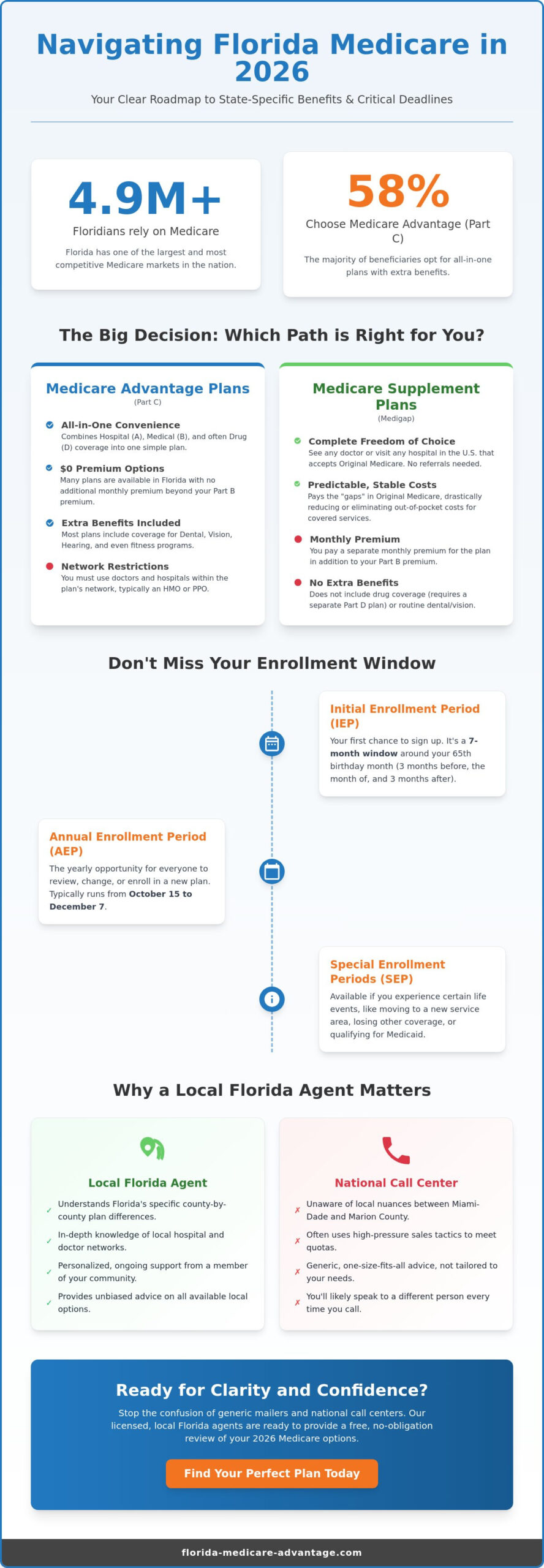
Medicare in Florida is divided into four main parts. Part A covers hospital stays, while Part B handles your doctor visits and outpatient care. Together, these form Original Medicare. Part D provides your prescription drug coverage. In Florida, Part C, also known as Medicare Advantage, is incredibly popular. Over 58% of Florida beneficiaries choose Medicare Advantage because these plans often include extra benefits like dental, vision, and even transportation that Original Medicare doesn’t offer. This high penetration rate is fueled by intense competition among providers in counties like Miami-Dade, Broward, and Hillsborough.
Many residents also qualify for help through the Medicaid program, which coordinates with Medicare for those with limited income. This coordination ensures that dual-eligible individuals receive comprehensive support without high out-of-pocket costs. Our licensed agents often see how these combined benefits provide a much-needed safety net for Florida seniors on a fixed income.
The Role of the Florida Department of Management Services
The Florida Department of Management Services (DMS) focuses specifically on health benefits for state employees and retirees. If you’re a retired state worker, your coverage often integrates with federal Medicare, but it’s managed separately from the plans available to the general public. For most seniors, the DMS won’t be your primary point of contact for the state of florida medicare options. The Agency for Health Care Administration (AHCA) is the primary body responsible for health facility licensure and healthcare data sharing across the state.
Federal Guidelines vs. Local Florida Plan Availability
Your Florida zip code is the most important factor in your plan availability. A resident in Orlando will have different plan options than someone in rural Liberty County. This geographic variation occurs because private insurance companies decide which counties they will serve each year. Because Florida has such a dense senior population, we often see more robust benefits and lower premiums than in less populated states. If you’re new to Medicare, starting with a local map of options is the best way to find peace of mind. Our local experts provide a no-obligation review to help you compare these variations and secure the savings you deserve for 2026.
Medicare Advantage vs. Supplement Plans in Florida
The state of florida medicare landscape in 2026 continues to be defined by a clear divide between two distinct paths. On one side, Medicare Advantage offers an all-in-one approach that often starts with a $0 monthly premium. On the other, Medicare Supplement (Medigap) plans provide a traditional fee-for-service experience with total freedom of choice. Deciding between them isn’t about finding the “best” plan, but rather finding the one that fits your specific health habits and budget. Florida’s high population of retirees means our market is incredibly competitive, which benefits you as a consumer through lower costs and more robust benefits.
Why Medicare Advantage Dominates the Florida Market
Medicare Advantage, or Part C, is the most popular choice in the Sunshine State. In many Florida counties, more than 50% of eligible seniors choose these plans. The primary driver is the “Zero Premium” culture. You continue to pay your Part B premium, but the private insurer charges nothing extra for the plan itself. These plans bundle hospital, medical, and prescription drug coverage into one card.
For 2026, we’re seeing an increase in “lifestyle” benefits. These go beyond basic medical care to include:
- Comprehensive dental, vision, and hearing coverage with high annual allowances.
- Silver Sneakers memberships at local fitness centers across Florida.
- Transportation to medical appointments and grocery stores.
- Allowances for healthy food and over-the-counter pharmacy items.
Local networks play a huge role here. Carriers like Florida Blue and Humana have built deep relationships with Florida medical groups. If your preferred doctor is in a specific HMO or PPO network, these Medicare Advantage Plans can be very cost-effective. For those with lower incomes who also qualify for state assistance, the Statewide Medicaid Managed Care (SMMC) program works alongside these plans to coordinate long-term care needs.
Choosing Medicare Supplement Plans in the Sunshine State
Medigap plans appeal to a different type of Florida senior. If you spend your winters in Florida but travel north for the summer, a Supplement plan is likely your best option. These plans are standardized from A to N, meaning a Plan G with one company offers the exact same coverage as a Plan G with another. The main difference is the price.
The biggest advantage is the lack of networks. You can visit any specialist in the country who accepts Medicare. You don’t need a referral, and you’ll never worry about a doctor leaving a plan network. This predictability is why many residents prefer to compare Medicare Supplement plans
Florida Medicaid and Medicare: D-SNP for Dual Eligibles
The most common misconception regarding the state of florida medicare landscape is the belief that Medicare and Medicaid are the same program. They are distinct systems with different purposes. Medicare is a federal program based primarily on age or disability, while Medicaid is a joint state and federal program designed for those with limited income and assets. For many Floridians, these two programs overlap. When you qualify for both, you are considered “dual eligible,” which opens the door to significant savings and specialized care options.
Florida Medicaid acts as a safety net by covering costs that Medicare does not. Depending on your income level, the state may pay your Medicare Part B premiums, deductibles, and co-insurance. According to Florida Medicare Enrollment Statistics, a substantial portion of the state’s 4.9 million beneficiaries utilize some form of state assistance to manage their healthcare costs. Florida categorizes this assistance into three main tiers:
- Qualified Medicare Beneficiary (QMB): This program provides the highest level of support, covering Part A and Part B premiums, deductibles, and co-pays.
- Specified Low-Income Medicare Beneficiary (SLMB): This tier specifically pays for the monthly Part B premium.
- Qualifying Individual (QI): This helps with Part B premiums for those who have slightly higher income than the SLMB threshold but still require financial assistance.
Qualifying for Extra Help in Florida
Applying for assistance starts with understanding the income and asset limits. For 2026, the Florida Department of Children and Families evaluates your monthly income and total countable assets, such as bank accounts or stocks, to determine eligibility. If you qualify for any level of Medicaid, you automatically qualify for “Extra Help,” a federal program that subsidizes Part D prescription drug costs. This program can lower your medication co-pays to just a few dollars, providing immense relief for those on a fixed budget. You can apply for these benefits through the Social Security Administration or by working with a local licensed agent who understands the Florida-specific application process.
Benefits of a Florida D-SNP Plan
A Dual Eligible Special Needs Plan (D-SNP) is a type of Medicare Advantage plan specifically for those who have both Medicare and Medicaid. These plans go beyond standard coverage by offering highly coordinated care. In Florida, D-SNP providers frequently include extra benefits like non-emergency transportation to medical appointments and monthly allowances for healthy groceries or over-the-counter supplies. D-SNP plans bridge the gap between state and federal aid by integrating Medicaid’s social support services with Medicare’s clinical medical coverage under one managed plan. This ensures your doctors, specialists, and pharmacists work together to manage chronic conditions effectively while protecting your financial security.
Critical Enrollment Deadlines for Florida Residents
The state of florida medicare system operates on a strict calendar. Missing a single date can lead to permanent financial penalties or a loss of access to preferred doctors. You need to track these windows carefully to ensure your 2026 coverage remains uninterrupted and cost-effective. Each window serves a specific purpose, from initial sign-ups to annual plan adjustments.
The Annual Enrollment Period (AEP) is the most significant date for most seniors. It runs from October 15 through December 7. During this time, you can switch from Original Medicare to a Medicare Advantage plan or change your Part D prescription drug coverage. Changes made during AEP take effect on January 1, 2026. If you’re already enrolled in a Medicare Advantage plan and find it doesn’t meet your needs, the Open Enrollment Period (OEP) provides a second chance between January 1 and March 31. During this time, you can switch to a different Advantage plan or return to Original Medicare.
- Initial Enrollment Period (IEP): A 7-month window around your 65th birthday.
- Annual Enrollment Period (AEP): October 15 – December 7 for all beneficiaries.
- Medicare Advantage Open Enrollment (OEP): January 1 – March 31 for current Advantage members.
- Special Enrollment Periods (SEP): Triggered by specific life events like moving or losing employer coverage.
Turning 65 in Florida: A Step-by-Step Timeline
Your Initial Enrollment Period is a seven-month window. It begins three months before you turn 65, includes your birth month, and ends three months after. If you’re already receiving Social Security benefits, the government usually enrolls you automatically. If you aren’t receiving benefits, you must contact the Social Security Administration yourself to sign up. Speaking with a local licensed agent during the first three months of this window is the best way to compare the state of florida medicare options available in your specific county.
Delaying enrollment without “creditable” coverage leads to lasting financial consequences. The Part B late enrollment penalty adds 10% to your monthly premium for every full 12-month period you were eligible but didn’t sign up. This penalty stays with you for life. Similarly, the Part D penalty adds 1% of the national base beneficiary premium for every month you go without drug coverage. You can explore your specific Turning 65 Medicare Options to avoid these costly mistakes.
Moving to Florida: Medicare Rules for New Residents
Florida is a top destination for retirees, but moving here from another state requires quick action. When you change your permanent residence, you qualify for a Special Enrollment Period. This window typically lasts for two months after the month you move. It allows you to choose a new plan that fits the provider networks in your new Florida city, whether you are moving to Jacksonville, Miami, or the Gulf Coast.
First, update your address with the Social Security Administration immediately. Your current plan from your previous state likely won’t work here because Medicare Advantage and Part D plans are tied to specific service areas. If you don’t select a new plan within your SEP window, you could be left with only Original Medicare and no drug coverage. For a deeper look at how these timelines work for new residents, review our Medicare Enrollment Periods guide.
Understanding these dates ensures you don’t pay more than necessary for your healthcare. If you’re unsure which window applies to your current situation, speak with a local licensed agent for a no-obligation review of your 2026 options.
Why a Local Florida Medicare Agent Outperforms National Call Centers
Choosing a health plan for the state of florida medicare landscape involves more than just comparing monthly premiums. National call centers often operate from hundreds of miles away. Their representatives use scripts designed for a general audience, but Florida’s healthcare market is anything but general. A local agent understands the specific footprints of hospital networks like AdventHealth, Baptist Health, or Mayo Clinic in Jacksonville. We know which plans actually provide access to the specialists you trust in your own neighborhood.
National brokerages often prioritize high-volume sales. This leads to high-pressure tactics that can leave you with a plan that doesn’t fit your lifestyle. Local experts take a different approach. We focus on long-term relationships because we are your neighbors. We provide personalized plan reviews that verify your specific Florida doctors are in-network before you sign anything. If a claim is denied or a coverage issue arises in 2026, you won’t be stuck in a generic phone queue. You’ll have a local advocate ready to resolve the problem.
The No-Obligation Review Process
A consultation with a Florida Medicare Advantage agent is designed to be educational and stress-free. During this review, we analyze your current medications and healthcare usage to find the most cost-effective options. You don’t have to worry about hidden fees for this service. Insurance carriers pay licensed agents directly, so there’s zero cost to the senior for professional guidance. This ensures you can accurately compare the best Medicare Advantage plans without any financial risk. We provide a clear breakdown of co-pays, maximum out-of-pocket limits, and extra benefits like dental or vision care.
Accessing Local Resources Like SHINE
The SHINE (Serving Health Insurance Needs of Elders) program is a vital resource in Florida. It offers free, unbiased health insurance counseling through the Florida Department of Elder Affairs. While SHINE provides excellent general education, their volunteers cannot enroll you in specific plans or provide year-round policy management. Our agents work alongside these state resources to provide total clarity. We take the foundational knowledge provided by SHINE and apply it to the technical enrollment process. This collaborative approach ensures you have both state-level education and professional-grade enrollment support. Our goal is to make the state of florida medicare easy to understand so you can move forward with confidence.
Ready to secure your coverage for 2026? Speak with a Licensed Florida Medicare Expert today for a personalized consultation.
Secure Your Healthcare Future in Florida for 2026
Navigating the state of florida medicare in 2026 doesn’t have to be a source of stress for your household. You’ve seen how the landscape is shifting, from the critical Annual Enrollment Period running October 15 through December 7 to the specific benefits offered by D-SNP plans for dual eligibles. Whether you’re weighing the premiums of a Medicare Advantage plan or the predictable costs of a Supplement policy, the right choice depends on your unique medical history. Our Licensed Florida Health Insurance Agents provide the clarity you need by comparing top-rated carriers like Florida Blue and Humana. We focus exclusively on Florida seniors because national call centers often miss the local network nuances that affect your specific care. You deserve a plan that fits your budget and your doctor’s office without the high-pressure sales tactics. Take the next step toward a confident 2026 by securing your coverage with a professional who knows your neighborhood. Get Your Free, No-Obligation Florida Medicare Review and experience the difference that local expertise makes for your peace of mind. Your health is your most valuable asset, and we’re here to help you protect it.
Frequently Asked Questions
Is Medicare the same as Florida Medicaid?
No, Medicare and Florida Medicaid are separate programs with different eligibility rules. Medicare serves seniors aged 65 and older or those with specific disabilities. Florida Medicaid provides health coverage for low-income individuals and families. In 2024, a single person’s income limit for Florida’s Aged and Disabled Medicaid program is $1,255 monthly. Some residents qualify for both, which provides extra help with healthcare costs through dual enrollment.
How do I apply for Medicare in the state of Florida?
You apply for Medicare through the Social Security Administration online, by phone, or at a local office. Most Florida residents enroll during their Initial Enrollment Period, which begins three months before their 65th birthday. If you’re already receiving Social Security benefits, the government enrolls you automatically. Navigating the state of florida medicare options requires careful timing to avoid lifelong late enrollment penalties that increase your monthly costs.
What is the SHINE program in Florida?
SHINE is a program through the Florida Department of Elder Affairs that offers free, unbiased Medicare counseling. Volunteers provide personalized assistance to seniors and caregivers regarding health insurance options. In 2023, SHINE counselors assisted over 150,000 Floridians with their coverage questions. This state-sponsored resource helps you understand your benefits without any sales pressure from insurance companies. It’s a reliable way to get clear answers about your local options.
Can I keep my Florida Medicare plan if I move to another state?
You can keep Original Medicare (Parts A and B) anywhere in the U.S., but private plans like Medicare Advantage are location-specific. If you move out of your plan’s service area, you’ll trigger a 63-day Special Enrollment Period to choose a new plan in your new state. Notifying your provider 30 days before your move ensures you don’t experience a gap in your medical coverage. This transition period allows you to maintain your healthcare access.
Does Florida have its own Medicare Part D drug plans?
Florida residents choose from private prescription drug plans that the federal government approves each year. In 2024, Florida offered 21 different standalone Part D plans with varying premiums and formularies. These plans help cover the cost of medications and protect you from high out-of-pocket expenses. Reviewing your prescriptions annually is essential because plan drug lists change every January 1. This annual review ensures your specific medications remain covered at the lowest possible price.
Are Medicare Advantage plans free in Florida?
Many Medicare Advantage plans in Florida offer a $0 monthly premium, but they aren’t entirely free of cost. You must continue paying your monthly Medicare Part B premium, which is $174.70 for most beneficiaries in 2024. While the plan premium might be zero, you’ll still face co-pays and co-insurance when you visit doctors or specialists. These plans often include extra benefits like dental and vision to provide a more comprehensive level of care.
Who is the best Medicare Advantage provider in Florida for 2026?
The best provider depends on your specific health needs and budget, though CMS Star Ratings offer a clear quality benchmark. In the current state of florida medicare market, several carriers consistently earn 4 or 5 stars for clinical performance and customer service. We recommend comparing providers like UnitedHealthcare, Humana, and Florida Blue based on their 2026 network size and drug formularies. A local agent can help you compare these top-rated options for your specific county.
When is the next Medicare open enrollment in Florida?
The next Medicare Annual Enrollment Period runs from October 15 through December 7, 2025, for the 2026 plan year. During these 54 days, you can switch from Original Medicare to a Medicare Advantage plan or change your current drug coverage. Changes made during this window take effect on January 1. It’s the primary time for Florida seniors to optimize their benefits and lower their healthcare costs through a no-obligation review with a local expert.